
Yaygirr
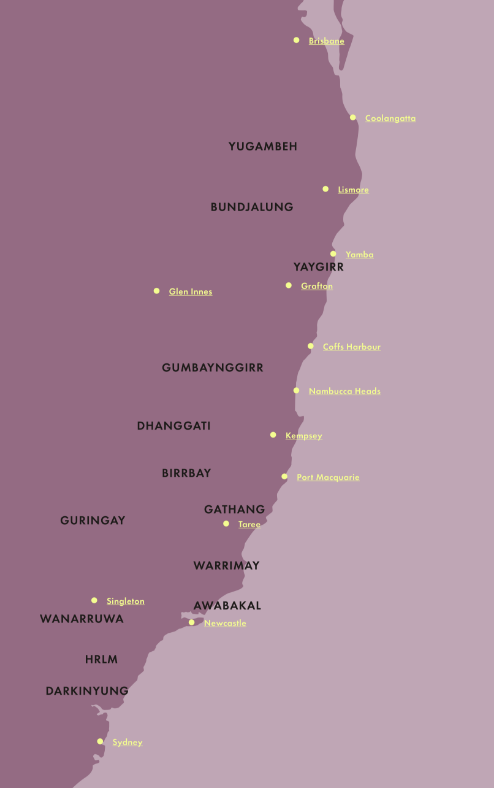
The ancestors of the present day Yaegl people lived around the mouth of the Clarence River and spoke a language, Yaygirr that was closely related to Gumbaynggirr. As early as 1929 the linguist Gerhardt Laves was told there were only two Yaygirr speakers left. Besides possibly making contact with the Yaygirr speaker Jack Freeburn, Laves was given a valuable set of Yaygirr words by Jack Cameron though he was not able to get language from Jack’s father.
Most of the Yaygirr audio recordings were given by Jack’s son, Sandy Cameron to William Hoddinott and Terry Crowley. Unfortunately, by then the language was no longer spoken right through.
There is evidence the Yaygirr had permanent settlements and a developed material culture. Matthew Flinders (1799) described large bark huts with rounded passageway entrances which protect dwellers from wind and rain. Similarly Captain Perry (1839) described canoes of a superior construction. (See Eleanor H McSwan’s ‘A history of Yamba and Iluka’) Why were there so few speakers left by the 1900’s? The Yaegl people speak of at least one large massacre along the Clarence. Other evidence points to victimisation by farmers and disease took a heavy toll.
Besides Yaygirr proper, there were two other groups who spoke related dialects: Yirraygirr people who lived upriver of Maclean and the Yunggaya who lived around Ulmarra. The informant had known several Yunggaya people whose names Laves recorded with a cross: sadly they had all passed away.
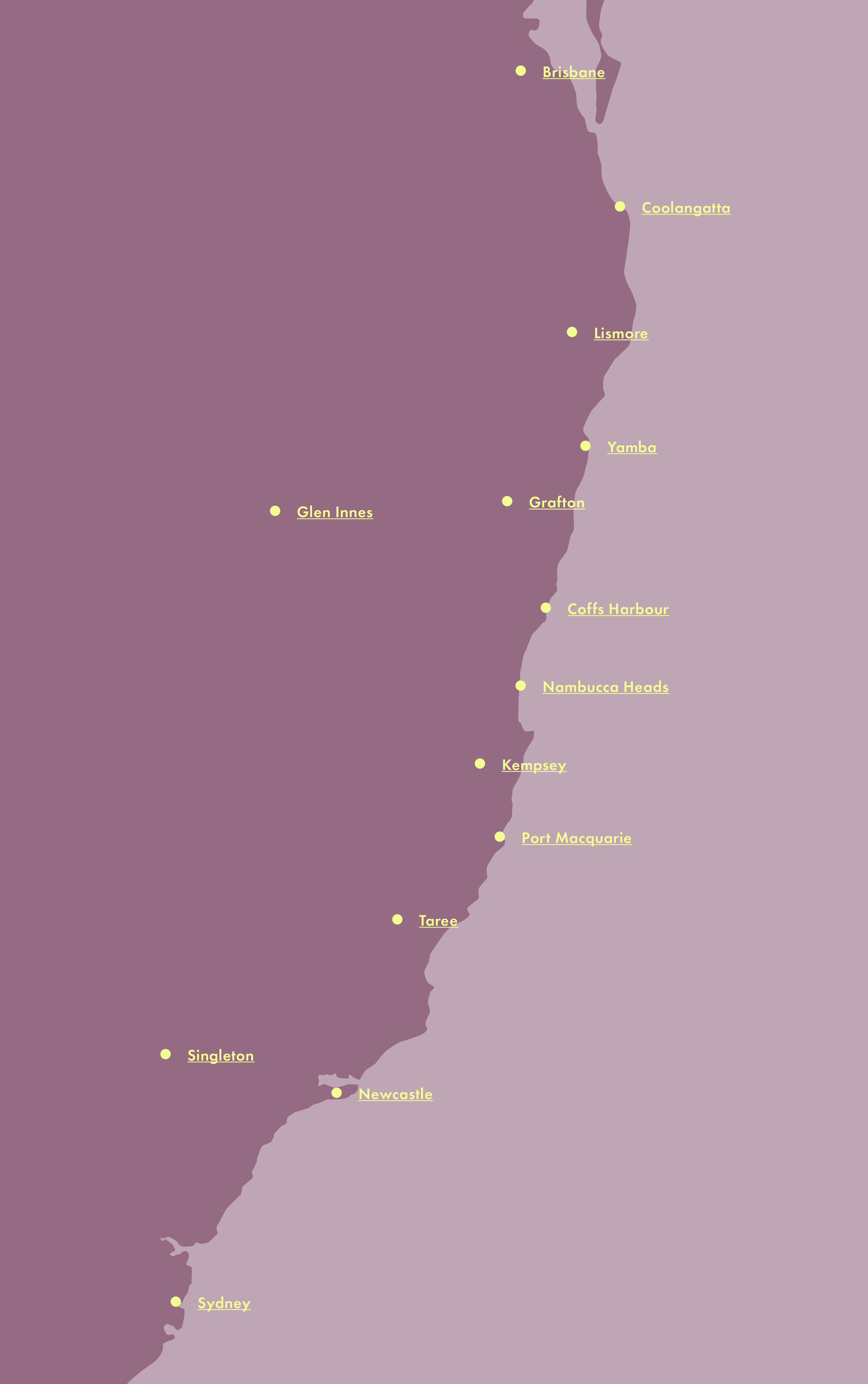
Yaygirr belongs to the Pama-Nyungan family of Australian languages. It is one of the two Gumbaynggirric languages, along with Gumbaynggirr itself.
Yaygirr is not a dialect of Gumbaynggirr: a person speaking only Yaygirr could not have understood Gumbaynggirr, though Terry Crowley’s (1979) wordlist showed that 74% of Yaygirr words and Gumbaynggirr words are closely related. Some are exactly the same: eg, ngaluunggirr means ‘clever-man’ in both languages. Many other words are only slightly different: ‘drink’ is ngambii in Gumbaynggirr and ngabii in Yaygirr.
A notable distinction between the two is found in the many words that start with a vowel (‘a’, ‘i’, or ‘u’ ) in Yaygirr (Y), which seem to have dropped the initial consonant of related Gumbaynggirr (G) words (no Gumbaynggirr words begin with a vowel). Yaygirr words beginning with a, such as aagal, ‘sea’ have generally dropped the g from gaagal (G). However, there is usually no reliable way of telling from the Yaygirr word what its Gumbaynggirr cousin looks like.
So ina ‘foot’ (Y) is jiina (G); ila ‘cook’ is yiila; and uraagay ‘possum’ is gurraagay (G). Sometimes a semivowel-beginning word in Yaygirr has a consonant-beginning Gumbaynggirr equivalent. Thus, yiinga (Y) ‘nose’ is related to jingaam (G); yanaambil (Y) ‘tongue’ is ganyaambil (G); and wuulun (Y) ‘rain’ is guluun (G).
Yaygirr has three kinds of rhotic (‘r’ sounds) one of which is probably not found elsewhere in Australia: Written with ‘rh’ it is an unvoiced trill: said like a Scottish ‘r’ but without using the voice box. People hearing the word dirha: ‘tooth’ for the first time might think they hear ‘deerssa’.
Written examples of the language
Language Resources
SOUNDS RECORDINGS
AIATSIS Sound Collection. Gumbaynggirr compilation tapes. (Compilation of Gumbaynggirr language material from the AIATSIS sound archive, 11585-15600).
Crowley, T. 1973. Language elicitation from the north coast of NSW. [AIATSIS Sound Collection CD 002762-002764]
Eades, D. 1974. Audio recordings of Gumbaynggirr speech elicited from Mr. Harry Buchanan. [AIATSIS Sound Collection A15595-9; Tapes 4497A – 4502B ; data incorporated into Eades (1979)]
Fillery, B.J., 1967, Audio Recordings of Gumbaynggirr language from Harry Buchanan and Les Nixon. [AIATSIS Sound Collection A15589-91. Tape 416A, B; 417A, B]
Gordon, J.A. 1968. Songs and discussion from Northern NSW. [AIATSIS Sound Collection Archive Nos. 001176 – 001177]
Hoddinott, W.G. 1965. Language elicitation and music (Field tapes) AIATSIS Sound Collection original recordings 22 – 28)
Hoddinott, W.G. 1977. Language elicitation, stories from Armidale area, NSW (Field tapes) AIATSIS Sound Collection Tape 4503 – 4509.
Mathews, Janet 1964. Language elicitation, vocabulary NSW (Field tapes) AIATSIS Sound Collection Tape 001015.