
Gathang
People
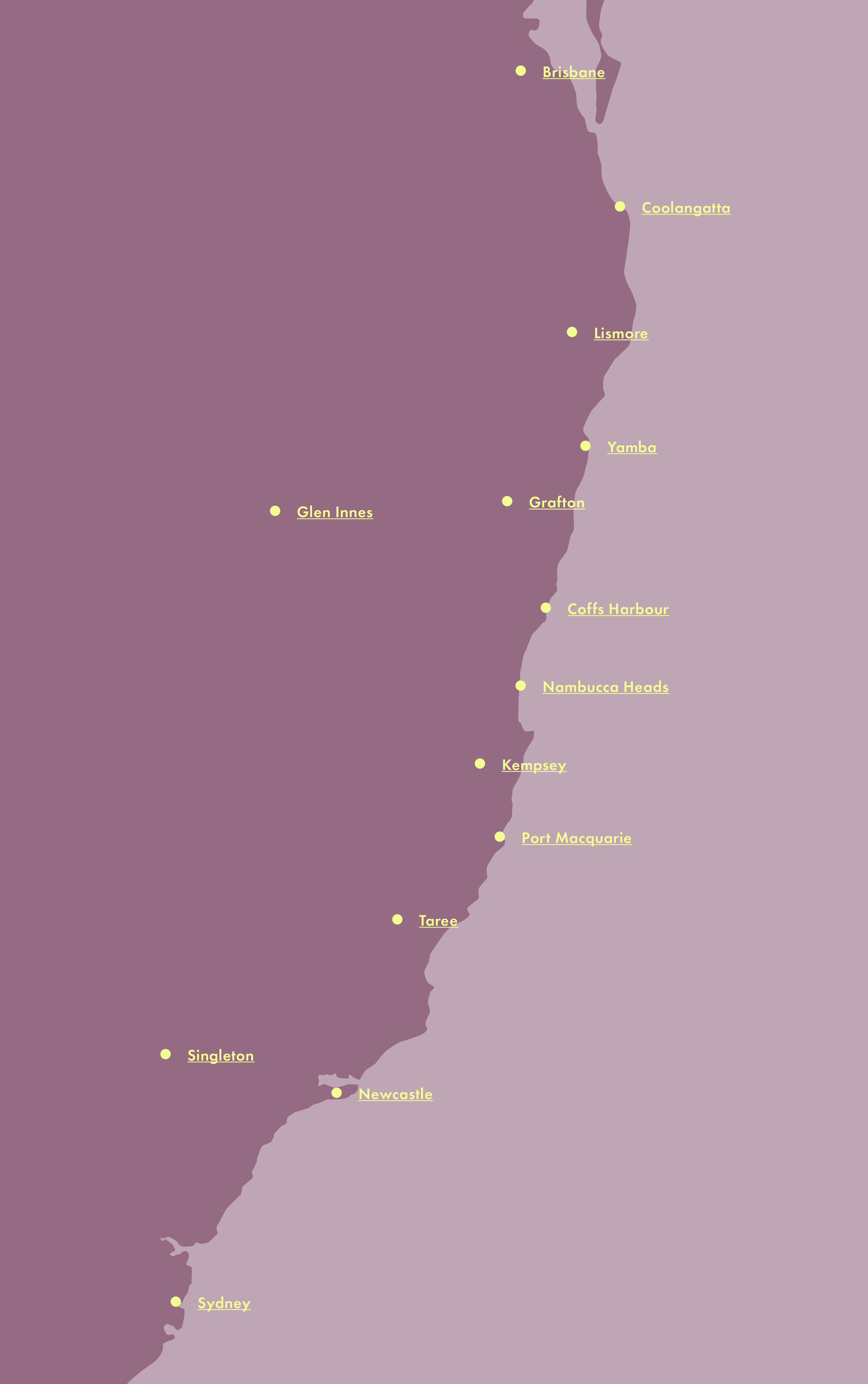
Traditional country
Outline of the language
Gathang language is classified as a Pama-Nyungan language. Recent studies indicate a close grammatical relationship with HRLM. There are many cognates (words which occur in both languages) as well as many structural similarities between the two languages. There are also a significant number of cognates in Gathang with Gumbaynggirr. There are many definitions in the Gathang vocabulary which have two words, where one word has a cognate from the south (HRLM) and the other has a cognate in the north, either Gumbaynggirr or Dhanggati.
Today, many Birrbay, Warrimay and Guringay people are involved in revitalising Gathang language, by learning language and using it in such areas as speeches, artwork, and radio broadcasting, and in naming people, organisations and buildings.
Alternative spellings include: Bahree, Cottong, Gadang, Gadhang, Guttahn, Karrapath, Carapath, Katanga, Kathang, Kattang, Katthung, Kittang, Kutthack, Kutthung, Watthung, Molo, Port Stephens tribe, Warimi, Warramie, Warrimee, Watthungk, Wattung, Worimi, Warrangine, Wannungine, Buraigal, Gamipingal, Maiangal, Garuagal, Gooreeggai, Goreenggai, Gourenggai, Gingai, Gooreenggai, Gringai, Birripai, Bripi, Biripai etc.
- Three vowels: i, a and u, each of which can also be pronounced as a longer vowel ii, aa and uu. It is not known if vowel length is contrastive. There are 13 consonants. The writing system developed for Gathang uses the voiced series for stops, and includes both pronunciations of the laminal stop (dh ~dj) and nasal (nh ~ny): b, d, dh ~dj, g, m, n, nh ~ny (~yn), ng, r, rr, l, w, y.
- Variant forms for words ending in a nasal have alternate pronunciations which end in a stop eg. Marrung ~marruk good, bakan ~bakat stone or rock.
- A system of noun suffixing (tag endings) to mark the grammatical roles of subject, object and agent, and other suffixes indicate instrument, location, movement towards, movement from, cause etc.
- Verbs have three tenses, past, present-habitual and future. Other suffixes convey different meanings, including ‘in order to’ do something, ‘want’ and ‘must’ do something, and ‘be’ something.
- Free word order, although there is a tendency towards agent – object – verb in a transitive sentence, unless there is focus on a non-agent participant.
Language resources
The historical record for Gathang language is, unfortunately, not particularly large in quantity or high in quality. Conversely, there are many place names in Gathang country in use in modern times, more than is usually found in NSW.
Several people recorded the language in the 1900s, with varying degrees of accuracy. In 1887 Curr published the earliest word list, compiled by John Branch. Enright wrote a description of the language and wordlist published in 1900. In 1929, the American linguist Gerhardt Laves worked with Charlie Briggs, Bill Dungie, Charlie Bugg, Jim Moy, Albert Lobban, Hannah Bugg, Susna Russell, Ted Lobban, Mrs Russell, Laves’ work is in the form of unpublished field notes. In 1961 an unknown compiler worked with Jim Davies. The linguist Nils Holmer made audio recordings in the 1960s with Eddie Lobban and Fred Bugg. From this he compiled a grammar, a wordlist and also published traditional and non traditional stories.
Following consultation with Gathang community groups and individuals, Muurrbay-MRALC linguist Amanda Lissarrague analysed the data from these and other sources, and we published A grammar and dictionary of Gathang: the language of the Birrbay, Guringay and Warrimay in 2010.
This provides a collection of all that is known about Gathang language at this point, a standardised writing system and will serve as a reference for the production of teaching and learning materials.
Branch, J 1887 “No 186: Port Macquarie” in EM Curr (ed.), The Australian Race. Melbourne: John Ferres, Government printer, 3:338-350.
Elkin, AP 1932 “Notes on the Social Organisation of the Worimi, A Kattang-Speaking People”. In Oceania, 2(3), 359-63.
Enright, WJ 1900 “The language, weapons and manufactures of the Aborigines of Port Stephens, NSW”. In Journal of the Royal Society of NSW, 34:103-18.
Enright, W J.1933. “Social Divisions of the Birripai”. In Mankind 1(5):102.
Holmer, N 1966, An attempt towards a comparative grammar of two Australian languages, Australian Institute of Aboriginal Studies, Canberra.
Holmer, N. 1967. An attempt towards a comparative grammar of two Australian languages, Part 2 Indices and vocabularies of Kattang and Thangatti, Australian Institute of Aboriginal Studies, Canberra.
Holmer, NM & Holmer, V, 1969, Stories from two native tribes of eastern Australia, Carl Bloms Boktryckeri, Lund.
Written examples of the language
Minyang nyura wuba-li-yn?
what you.all do-ing-PRES
What are you doing? (A common way of greeting is to ask a question.)
Nyura yii-gu mara-la barray-gu.
what you.all do-ing-PRES
you.all here-to come-have country-to.
You have come here, to this country.
(Yii barraba barray.)
this my country
This is my country.
Yii Gathang-guba barray.
this Gathang-‘s country
This is Gathang country.
Gathay nyiirun.
go-will we.all
Let us go together.
Gathang language revitalisation
- Development of a Certificate I in Aboriginal languages – Gathang in consultation with the Gathang Language Group, and delivered at TAFEs in Taree, Great Lakes and Port Macquarie
- Working with 2TLP Ngarralinyi radio in Taree to record a series of Gathang Language shows for the radio.
- Supporting the Gathang Language Group in developing protocols for language revival.
- Seeking funding for development and copying of language resources such as ‘Gathang stories’ an animated DVD of Uncle Eddie Lobban’s stories, developed by Uncle Jim and Tony Ridgeway, and recorded by Jeremy Saunders.
- Facilitating the development of an online version of the Gathang dictionary, in partnership with FirstVoices Canada.
- Many organisations are now learning Gathang language and welcoming people to country in Gathang.
- Ngarralinyi radio is using language in broadcasting where possible.
- People are using Gathang in welcomes and prayers in religious ceremonies, such as funerals.
- Some schools are introducing language.
- People are using Gathang in writing songs, storytelling and in artworks.
- Gathang is being used to name bush tucker gardens, buildings, accommodation/units, properties, and in business names.