Awabakal & Wonnarua
People
Traditional country
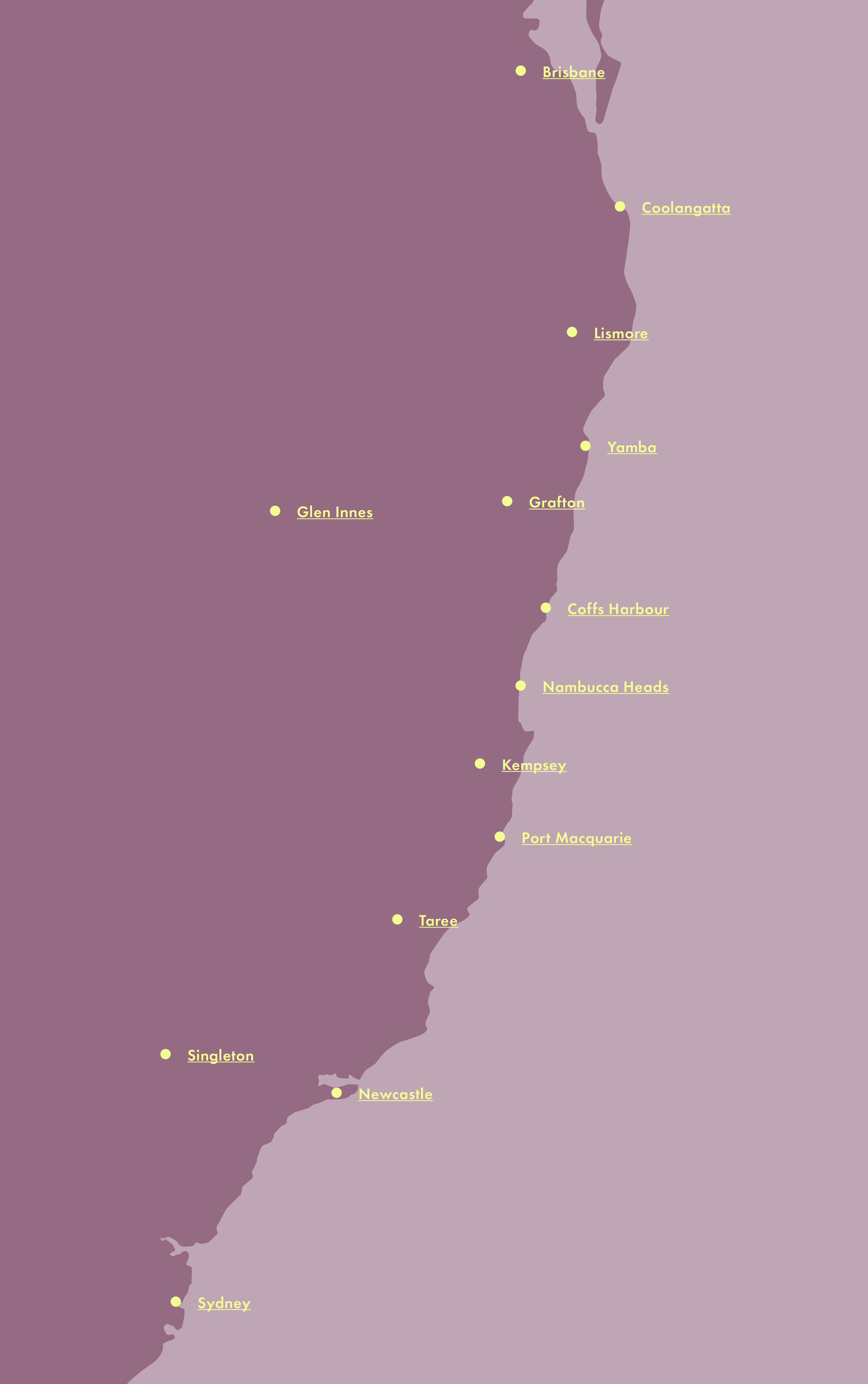
Language background
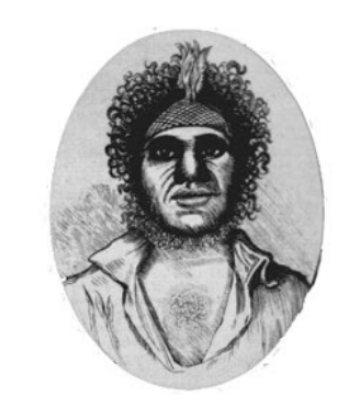
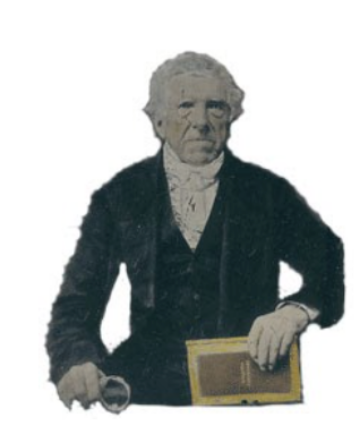
Biraban’s keen understanding of language structure enabled him to teach his own language to Threlkeld, and to assist with interpreting in court cases involving Aboriginal people.
He learnt English whilst working as a servant to Captain M. Gill at the military barracks in Sydney and also served as a tracker of escaped convicts. A more detailed description can be found here.
Alternative spellings and names include:
Awaba, Awabagal, Kuringgai, Karikal, Minyowa, Minyowie, Kuri, Wonnuaruah, Wannerawa, Wonarua, Wonnah Kuah, Wonnarua, Wanarruwa, Kayawaykal, Keawekal, Geawagal, Weawe-gal, Garewegal.
Outline of the language
- Three vowels: i, a and u, each of which can also be pronounced as a longer vowel (although it is not known if vowel length is contrastive) and 13 consonants. The writing system developed for HRLM includes voiceless stops and the palatal pronunciations of the laminal stop and nasal: p, t, tj, k, m, n, ny, ng, r, rr, l, w and y.
- A rich system of noun suffixing (tag endings) to mark the grammatical roles of subject, object and agent. Other suffixes indicate instrument, location, movement towards, movement from, cause, via, with, like, for etc.
- The pronouns have singular, dual and plural number, nine cases and the singular pronouns also have bound forms.
- Verbs have three tenses: present, past and future. Other suffixes convey different meanings, such as permit, want, make, each other, self, lest, for, etc.
- Sentences have free word order, although there is a tendency towards agent – object – verb in a transitive sentence, unless there is focus on a non-agent participant.
Language resources
Written examples of the language
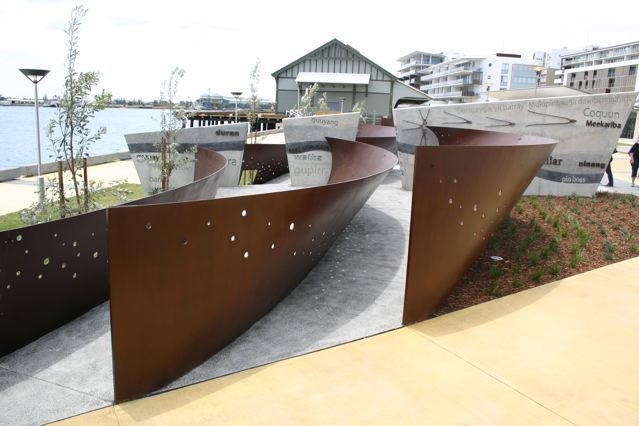
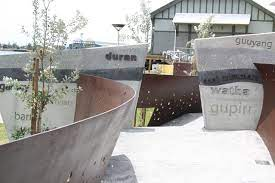
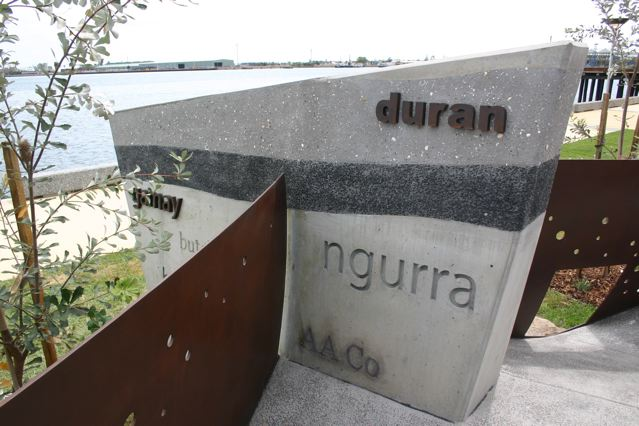
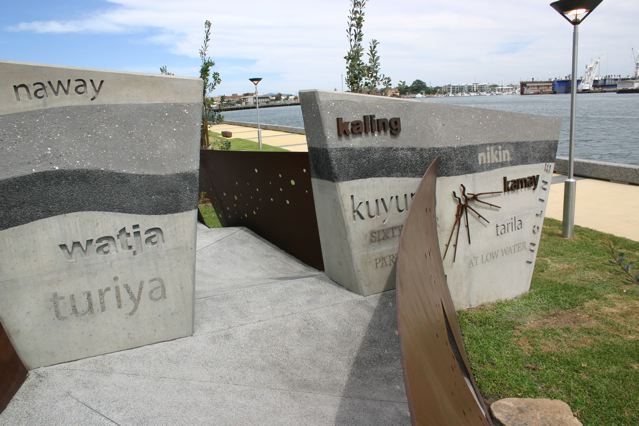
Worth Place Park – Honeyseckle Newcastle 2009
In 2007 Lillian Eastwood from the Guraki Aboriginal Advisory Committee of City of Newcastle Council consulted Muurrbay linguist Amanda Lissarrague outlining the possibility of incorporating local languages from Warrimay (Gathang) and the language from the Hunter River – Lake Macquarie for a public artwork commissioned by the Honeysuckle Development Corporation, Newcastle.
This sculpture designed by Zenscapes Landscape Architects Milne and Stonehouse, reflects layers of Aboriginal and English languages, and historically aspects of geology, maritime, and mining that continues to be evident in and around the mouth of the Hunter River.
“The languages and the representation of the midden in the artwork, convey the message that Aboriginal people occupied that space from long ago and had a great diverse life on the river. I personally believe if we can add and build the layer of Aboriginal language and history into the fabric of the Newcastle landscape then we build hopefully a safer, more tolerant and inclusive Novocastrian community” (Lillian Eastwood).